
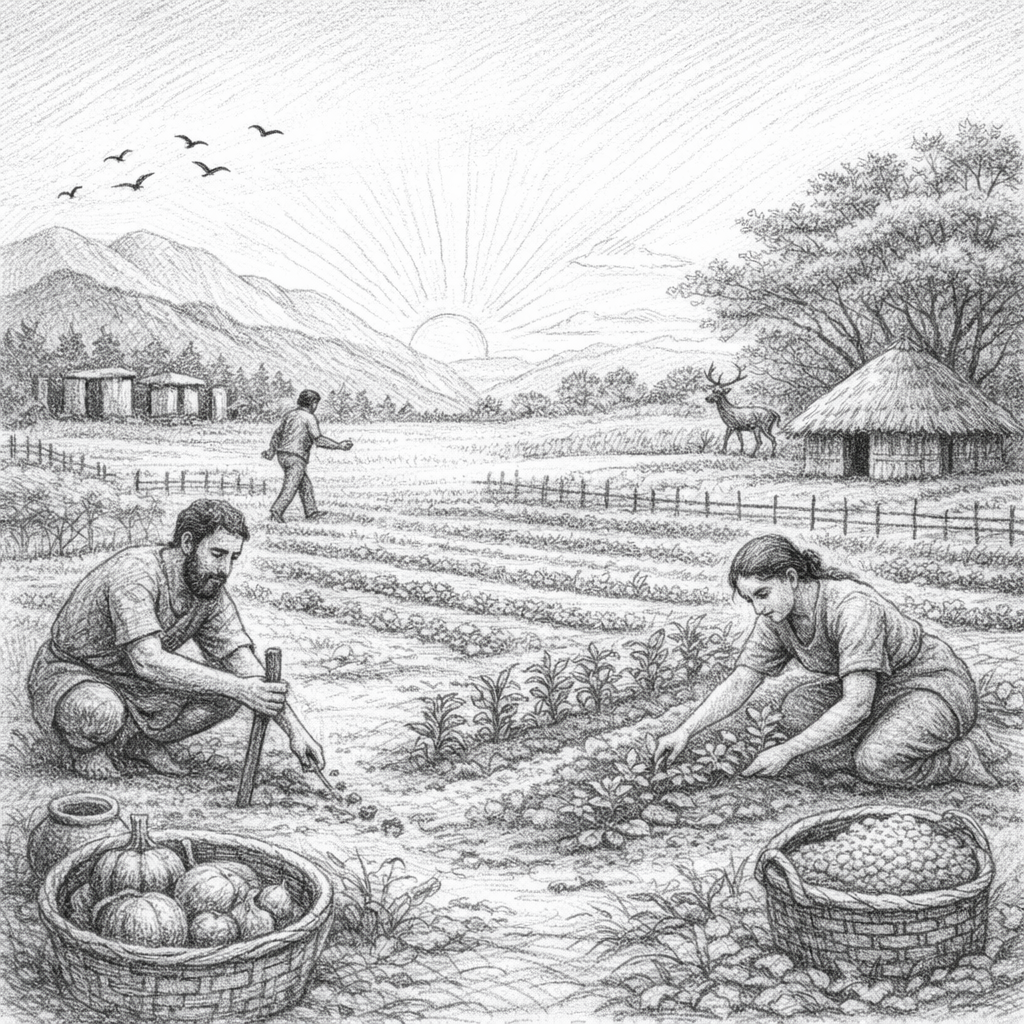
The first gardens were born from observation, patience, and necessity—long before metal tools or written calendars existed. Early cultivators learned to manage soil, crops, and seasons through intuition and adaptation, creating the foundation of agriculture that still sustains humanity today.
The Dawn of Cultivation
Roughly twelve thousand years ago, humanity began one of its most transformative experiments: the cultivation of plants. This shift from foraging to farming marked the beginning of settled life. In regions such as Mesopotamia’s Fertile Crescent, the Nile Valley, the Indus River basin, and the Yellow River plains of China, people discovered that seeds dropped near their camps sprouted new plants. Over generations, they learned to nurture these seedlings intentionally, turning wild landscapes into managed gardens.
These first gardens were small—patches of cleared land near rivers or dwellings—but they represented a profound change in human thought. Instead of chasing food across vast territories, people began shaping the land to meet their needs. They observed which soils produced the best yields, how rainfall affected growth, and how the timing of planting influenced harvests. Farming was not born from invention but from observation—the slow accumulation of wisdom passed down through generations.
Working the Soil Without Tools
Early cultivators had no iron plows or mechanical tillers. Their tools were simple: sticks, stones, bones, and wooden spades. Yet they understood the soil’s importance better than many modern farmers. In river valleys, floods deposited nutrient-rich silt that renewed fertility each year. In drier regions, people enriched the earth with ashes, animal manure, and decomposed plant matter—primitive composting that kept the soil alive.
They also practiced what we now call crop rotation. By alternating grains with legumes, they allowed the soil to recover naturally. Legumes replenished nitrogen, improving fertility for the next crop. This practice was not guided by science but by experience—farmers noticed that certain plants restored vigor to tired fields.
In Mesopotamia, early irrigation systems transformed arid land into productive farmland. Canals and dikes channeled water from the Tigris and Euphrates rivers, while in Egypt, the annual flooding of the Nile spread silt across the plains. These natural cycles became the heartbeat of agriculture. Farmers learned to read the river’s moods, timing their planting to the rise and fall of the waters.
The First Crops and Their Care
The earliest cultivated plants were hardy species that could survive unpredictable weather. In the Fertile Crescent, emmer wheat, barley, lentils, and chickpeas became staples. In China, millet and rice thrived; in Mesoamerica, maize and beans; and in South America, potatoes and quinoa. These crops were chosen for their resilience and nutritional value.
Seed selection was one of the first acts of human innovation. Farmers saved seeds from the healthiest plants, gradually improving yields through selective breeding. Over centuries, wild grasses became domesticated grains, and bitter roots became edible tubers. This quiet revolution reshaped ecosystems and diets alike.
Weeding and pest control were done by hand. Fire cleared land and discouraged weeds, while natural predators—birds, frogs, and insects—helped manage pests. Farmers learned to space plants for airflow and sunlight, reducing disease. Every task was laborious, but each improvement was a step toward mastery of the land.
Reading the Seasons
Without written calendars or meteorological instruments, early cultivators relied on the sky. The movement of the sun, moon, and stars guided their agricultural cycles. In Egypt, the rising of Sirius signaled the Nile’s flood and the start of planting. In Mesopotamia, constellations marked the changing seasons.
Farmers also observed the behavior of animals and plants. The migration of birds, the blooming of certain flowers, and the patterns of wind and rain all served as natural indicators. These observations evolved into agricultural calendars—systems of timekeeping that aligned human labor with nature’s rhythm.
Seasonal awareness was vital. A late frost or drought could destroy an entire harvest. To survive, communities diversified their crops and stored surplus grain in clay jars or underground pits. This foresight created stability and allowed trade between settlements.
Community and Cooperation
The first gardens were not solitary efforts. Farming required collective labor—clearing land, building irrigation channels, and protecting crops from animals. These tasks fostered cooperation and gave rise to permanent villages. Archaeological sites such as Jericho and Çatalhöyük reveal organized communities with granaries, ovens, and shared storage spaces.
Agriculture demanded planning, and planning required communication. People began to measure, record, and share knowledge. The exchange of seeds and techniques between neighboring groups accelerated innovation. As humans migrated, they carried their crops and methods with them, spreading agriculture across continents.
This cooperation also shaped social structures. Roles emerged—farmers, builders, toolmakers, and traders—all contributing to the survival of the group. Farming was not just an economic activity; it was the foundation of civilization.
Adapting to Nature’s Challenges
Early cultivators faced constant threats: floods, droughts, pests, and soil exhaustion. Their responses reveal remarkable resilience. When irrigation caused salinization in Mesopotamia, farmers switched from wheat to salt-tolerant barley. In mountainous regions, they built terraces to prevent erosion and capture rainwater. In tropical areas, they practiced slash-and-burn agriculture, clearing small plots and allowing them to regenerate naturally.
These methods were not perfect—some caused long-term environmental damage—but they reflected a deep understanding of local ecosystems. Farmers learned to balance use and renewal, ensuring that the land could sustain future generations.
The Spiritual Connection to the Land
For early humans, gardening was not merely practical—it was sacred. The act of planting and harvesting was intertwined with ritual and belief. Many cultures viewed the earth as a living being, a mother who nourished and demanded respect. Offerings were made before planting, and harvest festivals celebrated abundance.
In Mesopotamia, the goddess Inanna symbolized fertility and grain; in Egypt, Osiris represented the cycle of death and rebirth through agriculture. These spiritual traditions reinforced the idea that humans were caretakers of the land, not its conquerors.
Legacy and Lessons
The first gardens were laboratories of human ingenuity. Without metal tools or modern science, early cultivators managed soil, crops, and seasons through observation, patience, and cooperation. Their practices—seed saving, crop rotation, composting, and irrigation—remain the foundation of sustainable agriculture today.
Modern technology has transformed farming, but the principles remain unchanged: respect for the land, understanding of natural cycles, and adaptation to change. The story of early cultivation reminds us that progress does not always mean complexity. Sometimes, the simplest methods—those born from harmony with nature—are the most enduring.
In the quiet rhythm of those first gardens, humanity discovered its partnership with the earth. Every seed planted was an act of faith, every harvest a testament to perseverance. Long before tractors and fertilizers, before science and industry, the first gardeners proved that survival—and civilization itself—begins with the soil beneath our feet.
